
Koalas are one of Australia's most iconic animals and are recognized around the world for their fuzzy ears and sleepy demeanor.
These marsupials are found primarily in the coastal regions of eastern and southern Australia, where they occupy eucalyptus forests and woodlands. In recent years, the koala population in Australia has faced numerous threats, including habitat loss, disease, and climate change, leading to a decline in numbers.
One of the biggest threats to the survival of koalas is habitat loss due to land clearance for agriculture, urban development, and forestry. Koalas are also threatened by climate change, which is causing droughts, fires, and a decline in the availability of food and water. In addition, disease, such as chlamydia, can have a significant impact on the health of koalas and their ability to reproduce.
Koalas have fingerprints that are almost identical to human fingerprints and are the only other species known to have such distinct fingerprints.
According to the latest estimates, there are approximately 330,000 koalas in the wild in Australia, down from an estimated 600,000 in the early 1900s.
In some areas, koala populations have declined by as much as 50% in the past 20 years. The largest populations of koalas are found in the states of Queensland and New South Wales, with smaller populations found in Victoria, South Australia, and the Australian Capital Territory.
Koalas have a slow rate of reproduction and mature relatively late compared to other mammals. Female koalas typically give birth to one joey (a baby koala) every two years.
The gestation period for a koala is approximately 35 days, and the joey spends the first six to seven months of its life in its mother's pouch. The young koala will then begin to venture outside the pouch and start to eat solid food.
Koalas are arboreal animals and spend most of their lives in eucalyptus trees, where they feed on the leaves and bark of various species of eucalyptus.
Koalas have a very specialized digestive system that allows them to extract the maximum amount of nutrition from their food, which is low in nutrients. To conserve energy, koalas spend up to 20 hours a day sleeping and are known to have a very low metabolism.

Koalas were hunted in large numbers between 1908 and 1927, causing their populations to decline significantly.
While they may occasionally fall prey to predators like goannas, eagles, and owls, the primary threat to koalas is habitat loss due to human activities such as deforestation and urbanization.
Dingoes and other large birds of prey can also pose a threat to young koalas.
Koalas are not strong swimmers, and their arboreal lifestyle makes them relatively clumsy on the ground. They tend to live in populations that are dispersed across their range, but will often occupy the same tree within a larger area of suitable habitat.
During the breeding season, male koalas may express territorial behavior by bellowing and marking trees with scent from their chest gland. Females may also emit these vocalizations during this time, but do not engage in territorial behavior.
The koala's closest living relative is the wombat, which is a stationary
burrower rather than a nomadic arboreal like the koala.
One clue to this relationship is the
common design of the pouch, which opens to the rear in both animals.
Mating season for koalas typically occurs from late winter to early spring, with a slightly earlier breeding season in northern regions compared to the south.
The gestation period is typically around 33 days, after which a single joey is born weighing only about 1 gram and measuring around 1.5 cm in length. The joey crawls from the mother's birth canal to the pouch and attaches to a teat for further development.
The joey leaves the pouch for the first time around 5 to 6 months of age, and will be permanently out of the pouch by the time it reaches 8 months old. During this period, the young joey continues to nurse while also exploring its environment and gradually transitioning to a diet of eucalyptus leaves. This process is known as weaning.
The average lifespan of a koala in the wild is around 10 years, although some individuals may live up to 15 years. In captivity, the lifespan can be even longer, up to 20 years or more.
Koalas vary in size depending on their geographic location, with the largest individuals found in Victoria and the smallest found in North Queensland. Koalas occupy a range of habitats across their distribution, but only where there is a sufficient supply of their preferred eucalyptus tree species.
Koalas are known to communicate with each other using a range of vocalizations, including snores and belches, collectively known as "bellowing."
Female koalas typically only have one offspring per year, with older females producing offspring less frequently.
At birth, koalas are known as "pouch young", "joeys", or simply "cubs". They are incredibly tiny, measuring only around 2 cm in length, or about the size of a jellybean.

Koalas have a slow rate of reproduction and mature relatively late compared to other mammals. Female koalas typically give birth to one joey (a baby koala) every two years. The gestation period for a koala is approximately 35 days, and the joey spends the first six to seven months of its life in its mother's pouch.
The young koala will then begin to venture outside the pouch and start to eat solid food.
Koalas have extra thick fur, especially on the neck and shoulders, helps protect the koala from even the worst weather.
Koalas do not build nests.
Pear-shaped body provides stability while the koala sits in trees.
Opposable thumbs and toes allow for a tight grip when climbing.
Rough pads on undersurface of hands and feet increase traction while the koala is climbing.
Rough pads on undersurface of hands and feet increase traction while the koala is climbing.
Large nose with sensitive hairs enables the
koala to detect differences in smell between different eucalyptus
leaves, ensuring that its diet consists of only the best of the bunch.
Cheek pouches allow animal to store food not yet
chewed while moving to a safer or more protected location.
The Koala cools itself by licking its arms and
stretching out as it rests in the trees (koalas have no sweat glands).
The biggest problem for koalas is that their bushland (or "habitat") is being cut down to make way for houses.
Koalas are protected by law but their homes and food aren't.
Another interesting fact about koalas is that they have a highly developed sense of smell and use this sense to locate suitable food and mates. Koalas have a large number of scent glands on their chest and stomach, which they use to mark their territory and to attract mates.
He was hit by a car and nearly died, but he survived.
Luckily Jimmy the koala was rescued and taken to a wildlife hospital.
Order Jimmy today, worldwide delivery is free.

Have a closer look at all of our adorable Aussie koala, kangaroo and wombat plush toys. Guaranteed to last a lifetime and completely non-allergenic.
 |
Visit Jimmy The Koala |
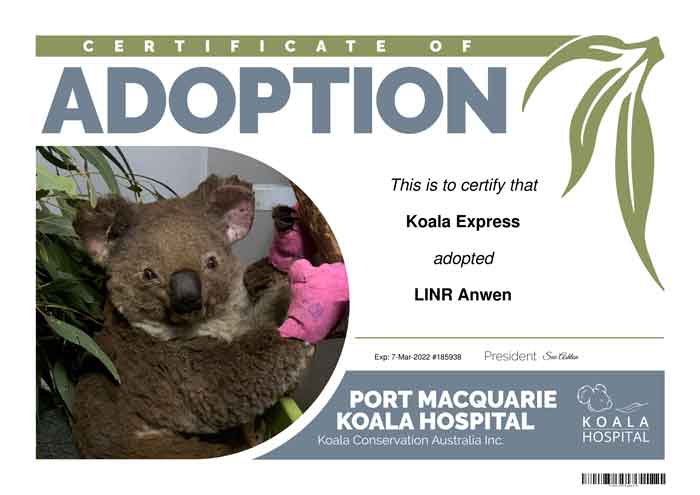
Welcome to Koala Express. The cutest koala, kangaroo and wombat plush toys. By purchasing a cuddly Australian made gift you are helping the survival of the Australian koala. We've been doing it since 2001. Our latest donations were to Koala Conservation Australia, Fauna Rescue SA, Mallacoota Wildlife Shelter and the Wildlife Preservation Society of QLD.


Add your own personal gift message and it will be included on a beautiful welcoming card.


