The name was first recorded as "Kangooroo or Kanguru" on 4 August 1770, by Lieutenant (later Captain) James Cook on the banks of the Endeavour River at the site of modern Cooktown, when HM Bark Endeavour was beached for almost seven weeks to repair damage sustained on the Great Barrier Reef.
Guugu Yimithirr is the language of the people of the area.
A common myth about the kangaroo's English name is that "kangaroo" was a Guugu Yimithirr phrase for "I don't understand you."
According to this legend, Lieutenant Cook and naturalist Sir Joseph Banks were exploring the area when they happened upon the animal.
They asked a nearby local what the creatures were called. The local responded "Kangaroo", meaning "I don't understand you", which Cook took to be the name of the creature.
A male kangaroo is called a boomer
A female kangaroo is called a flier
A baby kangaroo is called a joey
A Kangaroo is a marsupial mammal.
It is a macropod which means "big foot".
There are over 40 different types (species) of Kangaroo.
The smaller ones are usually called Wallabies.
The largest is the Red Kangaroo.
It stands taller than a man and can weigh 85 kg's.
It is the largest marsupial in the world.
On the Australian coat of arms the Emu and the Kangaroo were selected as symbols of Australia to represent the country progress because they are always moving forward and never move backwards.
Kangaroos are the largest marsupial mammals.
They belong to the Macropodidae family.

Kangaroos usually have one young annually. The young kangaroo, or joey,
is born at a very immature stage when it is only about 2 cm long
and weighs less than a gram. Immediately after birth it crawls up the
mother's body and enters the pouch. The baby attaches its mouth to one
of four teats, which then enlarges to hold the young animal in place.
After several weeks, the joey becomes more active and gradually spends
more and more time outside the pouch, which it leaves completely between
7 and 10 months of age.
Female kangaroos enter into heat within a few days after giving birth they mate and conceive, but after only one week's development does the microscopic embryo enter a dormant state that lasts until the previous young leaves the pouch.
The development of the second embryo then resumes and proceeds to birth after a gestation period of about 30 days.
There are 60 species of kangaroo and wallaby combined, but not all of them are called kangaroos. Some are called wallaroos, pademelons, or tree-kangaroos. Ranging in size from the two-pound rock wallaby to the 6-foot, 300-pound red kangaroo.
The Kangaroo moves by hopping on its powerful hind legs. It uses its thick long tail to balance its body while hopping. A kangaroo can hop at up to 60kmh (40mph). It can also leap over obstacles up to 3m (10ft) high. Because of the unusual shape of its legs and its bulky tail a kangaroo can't walk or move backwards very easily. Kangaroos are found in Australia, Tasmania, and New Guinea.
They are grazing animals that eat grass, young shoots and leaves of heath plants and grass trees. Kangaroos need very little water to survive and are capable of going for months without drinking at all.
While it is true that kangaroos are adapted to dry environments and can obtain some of their water needs from their food, they still need to drink water regularly to survive, especially in hot weather.
The kangaroo usually rests in the shade during the day and comes out to eat in the late afternoon and night when its much cooler. It eats mostly grass. It needs very little water to survive. It can survive without drinking for months.

When a kangaroo is moving slowly the tail is used as an extra leg and supports the kangaroo when it is standing on its hind legs. Most kangaroos can only move both back legs together and not one at a time.
Kangaroos have good eyesight but only respond to moving objects. They have excellent hearing and can swivel their large ears in all directions to pick up sounds. Kangaroos are social animals that live in groups or "mobs" of at least two or three individuals and up to 100 kangaroos.
Kangaroos usually have one young annually. The joey remains in the pouch for nine months and continues to suckle until twelve to seventeen months of age. Kangaroos can have 3 babies at one time.
Kangaroos typically have only one offspring at a time and usually give birth to a new joey only after the previous one has left the pouch. Very rarely, a female kangaroo can have two offspring at different stages of development (e.g., one in the pouch and one outside),
There are 4 teats in the pouch and each provides different milk for the different stages of development.
Common name / Scientific name / Height Weight
Eastern Grey Macropus giganteus
3 - 8ft (0.9 - 2.4m) 40 - 200 lbs (18 - 95kg)
Red kangaroo Macropus Rufus
3 - 9ft (0.9 - 2.7m) 40 - 150 lbs (18 - 70kg)
Western Grey Macropus fuliginosus
3 - 7ft (0.9 - 2.1m) 63 - 120lbs (28 - 54kg)

Sometimes known as the "Forester" the Eastern grey kangaroo is the heaviest marsupial in the world. Males are larger than females (rarely exceed 45kg).Eastern grey kangaroo lives in small groups but may congregate in large numbers when feeding. It is usually active from late afternoon until early morning, resting in the shade of trees and shrubs during the day.
Kangaroos are the only large animals to use hopping as a means of locomotion. The comfortable hopping speed for a red kangaroo is about 20–25 km/h (12–16 mph), but speeds of up to 70 km/h (43 mph) can be attained over short distances, while it can sustain a speed of 40 km/h (25 mph) for nearly 2 km (1.2 mi).
This fast and energy-efficient method of travel has evolved because of the need to regularly cover large distances in search of food and water, rather than the need to escape predators. At slow speeds, it employs pentapedal locomotion, using its tail to form a tripod with its two forelimbs while bringing its hind feet forward. Kangaroos are adept swimmers, and often flee into waterways if threatened by a predator. If pursued into the water, a kangaroo may use its forepaws to hold the predator underwater so as to drown it.
They are able to clear a length of 25 feet (8 meters) and heights of 9 feet (3 meters). Eastern grey kangaroos generally give birth to one infant at a time but twins have been reported. A single young weighing less than 0.35oz (1gr) is born after a pregnancy of 36 days. The joey leaves the pouch for short periods in about nine months of age, but continues to be suckled until it is about 18 months of age.
If pursued into the water, a kangaroo may use its forepaws to hold the predator underwater so as to drown it.
They are able to clear a length of 25 feet (8 meters) and heights of 9 feet (3 meters). Eastern grey kangaroos generally give birth to one infant at a time but twins have been reported. A single young weighing less than 0.35oz (1gr) is born after a pregnancy of 36 days. The joey leaves the pouch for short periods in about nine months of age, but continues to be suckled until it is about 18 months of age.
The Red kangaroo is the largest marsupial in the world. The female is often called the "blue flyer" because of her blue-grey fur. In the eastern part males are usually red (pale red to brick red) and females a bluish grey, elsewhere, both sexes may be reddish/brown. Red kangaroos normally move in groups ("mobs") ranging from a few dozen to several hundred animals.
The Red kangaroo mob usually consists of a dominant male, a number of adult females, and juveniles of both sexes. Red kangaroo females are sexually mature at about eighteen months, males at about two years.
Red kangaroo joeys remain in the pouch for 5-6 months. Over a period of 2-3 months they gradually spend more time away from the pouch usually weaned by one year of age, but normally remain close to the mother for another 6 months.
The Western grey kangaroo looks much like the Eastern grey kangaroo, and for many years was treated as subspecies. They vary in color, being anywhere from greyish-brown to chocolate brown.
The muzzle is covered in fine hair.
The western group is slender and greyish-brown in color, and the southern group is stockier and brown in color.
Western grey kangaroo males are known as stinkers due to their strong, curry-like smell.
Western grey kangaroos are very vocal.
The mothers communicate to the joeys with a series of clicks. Western grey kangaroos have no particular breeding season, although most joeys are born in the summer. The Western grey kangaroo is related to the Eastern grey and Red kangaroos.
Eastern grey kangaroo estimate population in 2011
was 16,057,783
Eastern grey kangaroos are distributed throughout most of the eastern third
of the Australian continent, especially along the coast
in damp forest and scrub. It has increased in numbers
since European settlement due to pasture improvement, and
the provision of watering points for stock.

Red kangaroo estimated population in 2011 was 11,514,298
Red kangaroos are distributed throughout inland Australia and occupy
mixed habitats of open shrub lands, grasslands, male scrubs,
Mulga country, and desert absent from the wetter areas
of eastern, northern and south-western Australia.

Western Grey kangaroo estimated population in 2011 was 2,348,393
Western grey kangaroos inhabit 60% of western and
southern Australia. The southern group can be found in
South Australia, Victoria, and New South Wales. They
live in woodlands, open forests, coastal heath land,
open grassland, scrubland and also can be found on city
outskirts and golf courses.
Kangaroo numbers are increasing throughout Australia. They are now
found in greater numbers than prior European settlement due to
provision of pasture and additional water points. Since the
extermination of its natural predator, the Tasmanian wolf,
and because of its rapid reproductive abilities this animal
has overpopulated.

All kangaroos have a chambered stomach similar to cattle and sheep. They regurgitate the vegetation they have eaten, chew it as cud, and then swallow it again for final digestion.
The Red kangaroo grazes during the night on a wide variety of grasses and low herbaceous plants, though sometimes this grazing period starts late evening and ends early morning When water is available it will drink but, if it obtains sufficient green food, it does not need to do so.
Western grey kangaroos feed mostly on grass but will
browse upon certain native shrubs. They are strictly
herbivorous and use microorganisms in the caecum to
break down the cellulose of these plants.
They can survive on plants high in fiber but low in nitrogen, and require very little water.
The kangaroo fights by attacking its opponent with its front paws (which have sharp claws)
or by kicking them with its powerful hind legs.
The cutest little kangaroo in Australia you can own!

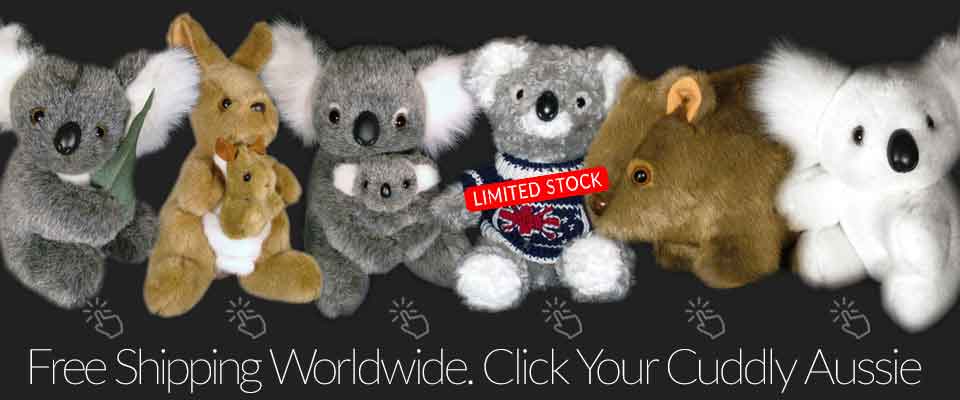
Have a closer look at all of our adorable Aussie koala, kangaroo and wombat plush toys. Guaranteed to last a lifetime and completely non-allergenic.
 |
Visit Jimmy The Koala |
Welcome to Koala Express. The cutest koala, kangaroo and wombat plush toys. By purchasing a cuddly Australian made gift you are helping the survival of the Australian koala. We've been doing it since 2001. Our latest donations were to Koala Conservation Australia, Fauna Rescue SA, Mallacoota Wildlife Shelter and the Wildlife Preservation Society of QLD.


Add your own personal gift message and it will be included on a beautiful welcoming card.


